
…experts call for result-based management, stronger project oversight
The Lagos State Government has reaffirmed its commitment to strengthening monitoring and evaluation (M&E) as a critical tool for improving project delivery, promoting accountability and ensuring that public investments translate into measurable benefits for residents.
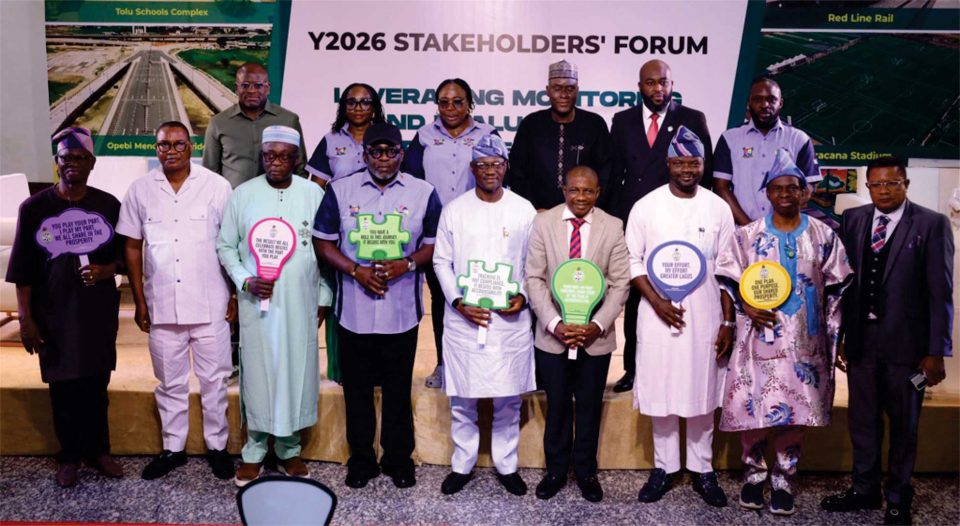
The commitment was reiterated at the 2026 Monitoring and Evaluation Stakeholders’ Forum with the theme, “Leveraging Monitoring and Evaluation to Advance Shared Prosperity: Chart the Course, Track the Result, Share the Prosperity,” organised by the Ministry of Economic Planning and Budget on Wednesday in Alausa, Ikeja.
In his address, the Commissioner for Economic Planning and Budget, Mr. Ope George, said Lagos State has long distinguished itself as a pacesetter in innovative governance and public sector excellence, noting that the Government had institutionalized monitoring and evaluation across the entire project cycle, beginning with the annual budget process through consultations with residents across the IBILE (Ikeja, Badagry, Ikorodu, Lagos Island and Epe) divisions to identify priority projects.
Speaking on the essence of the forum, he said, “We must continue to modernise our systems and build institutional capacity to ensure that Lagos remains at the forefront of public sector innovation. Let us move beyond identifying challenges and focus on practical, innovative and collaborative solutions that will strengthen our monitoring and evaluation ecosystem and accelerate sustainable development.”
Explaining part of the Ministry’s callings, the commissioner said, “We don’t wait until projects are completed. Our Monitoring and Evaluation Department follows projects from the planning stage through implementation, evaluating progress, reporting findings and working closely with the relevant Ministries, Departments and Agencies.
“For every single project that the state undertakes, every naira and kobo is monitored, evaluated and accounted for,” George expressed, noting that no project is considered too small because each one directly affects the lives of Lagos residents.
The Commissioner noted that the monitoring framework covers all government projects, including major infrastructure such as the Opebi-Mende Bridge, Massey Children’s Hospital, and rail projects, as well as the Food Logistics Hub, as well as education, healthcare, and community development initiatives.
He also highlighted that technology is playing an increasing role in project monitoring through digital platforms such as the EKO360 App, while emerging technologies, including Artificial Intelligence, are expected to strengthen data collection, project tracking and evidence-based decision-making across government.
Delivering a presentation titled ‘Result-Oriented Monitoring and Evaluation Mechanism for Budget Efficiency, Effectiveness and Equity’ on strengthening public sector performance, former Minister of Finance and National Planning, Dr. Shamsuddeen Usman, called for the institutionalisation of Results-Based Management as a framework for improving governance.
Represented by Mr Aliyu Aminu Ahmed, the pioneer president of the Nigeria Association of Evaluators, NEA, stressed that governments should no longer be assessed by the volume of projects executed or the amount of money spent, but by measurable improvements in the quality of life of citizens.
According to him, “efficiency, effectiveness, impact and equity should remain the key indicators for evaluating government performance and ensuring that development interventions deliver lasting benefits.”
Also speaking, the Registrar-General of the Chartered Institute of Project Managers of Nigeria (CIPMN), Henry Mbadiwe, identified inadequate planning and weak project control mechanisms as major causes of project failures in the public sector.
He maintained that every successful project must begin with proper planning, a clearly defined project charter and a robust monitoring framework capable of managing risks, controlling project scope and evaluating results throughout the project lifecycle.
Mbadiwe urged public institutions to move beyond monitoring activities to measuring outcomes, noting that “projects only create prosperity when they are successfully delivered, effectively utilised and achieve their intended benefits.”
Earlier in her opening remarks, the Permanent Secretary, Ministry of Economic Planning and Budget, Mrs. Olayinka Ojo, described monitoring and evaluation as an indispensable instrument for achieving the aspirations of the Lagos State Development Plan (LSDP) 2052 and the THEMES+ Development Agenda.
She said meaningful development requires deliberate planning, diligent implementation, effective monitoring and continuous learning to ensure government interventions deliver measurable benefits to the people.
Mrs Ojo added that the forum was designed to deepen collaboration among stakeholders, promote the exchange of best practices and generate practical recommendations that would further strengthen the State’s monitoring and evaluation system.
Chairman of the Lagos State Community Development Advisory Council, Alhaji Amusat Azeez, commended the State Government for promoting community participation in project implementation. He said communities are increasingly involved in identifying priorities, monitoring project execution and taking ownership of completed projects, a process he described as critical to ensuring sustainability and accountability.
The forum brought together senior government officials, development partners, private sector representatives, civil society organisations, professional bodies, academia and community leaders to share ideas and practical strategies for strengthening monitoring and evaluation as a catalyst for transparency, improved service delivery and sustainable development in Lagos State.
